Playing ABBA Between the Orders: The Asian-American Small Businesses That Made Swedish Pop Part of Their Brand
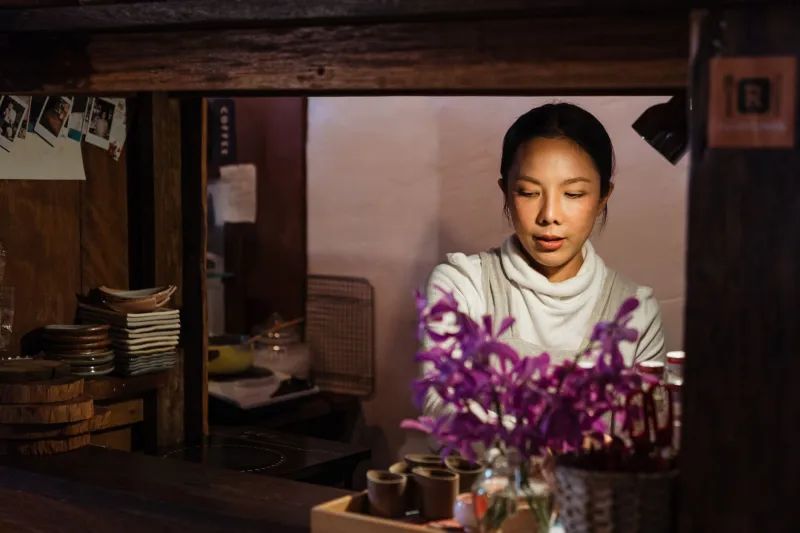
The lunch rush at Mei's Kitchen in Monterey Park, California runs on a reliable rhythm. Orders fly, steam rises off the wonton soup, and somewhere underneath the clatter of chopsticks and the cheerful chaos of a packed dining room, Agnetha Fältskog is quietly asking if you believe in angels. Nobody turns to look. Everyone just keeps eating, a little more content than they might otherwise be.
Owner Mei-Ling Chen has been playing ABBA in her restaurant for eleven years. She didn't overthink it at first. 'My mother played them when I was young,' she says, refilling a tea pot without breaking stride. 'I just... kept playing them. And then I realized people liked it. They stayed longer. They talked more.'
What Mei-Ling stumbled into, other Asian-American business owners have arrived at more deliberately: ABBA isn't just background noise. In the right hands, it's a brand strategy.
The Playlist as a Cultural Bridge
There's a particular challenge that comes with running an Asian-American small business in the US, especially one that wants to appeal to multiple generations and cultural backgrounds simultaneously. You want your space to feel authentic to your heritage without alienating customers who aren't familiar with it. You want warmth and sophistication. You want the kind of atmosphere that makes a first-time customer feel like a regular.
ABBA, it turns out, threads that needle remarkably well.
The music is immediately recognizable to most American customers, which provides a kind of cultural common ground. But it also carries specific emotional weight for many Asian immigrant families who discovered it during the '70s and '80s — a time when ABBA's records were circulating widely across Asia and among Asian immigrant communities in the US. Playing it in a business setting activates both registers at once: familiar pop for the general American customer, something closer to home for the immigrant community.
'It says we're sophisticated but we're also warm,' explains Danny Tran, who co-owns a Vietnamese-American nail salon in Fairfax, Virginia with his mother. 'ABBA isn't aggressive. It's not trying too hard. It's just... confident. That's what we want people to feel when they walk in.'
The Bubble Tea Effect
Among Asian-American food and beverage businesses, the trend is particularly visible — and audible — in the bubble tea sector. Boba shops occupy a fascinating cultural middle ground: they're deeply rooted in Asian (specifically Taiwanese) food culture, but they've also become mainstream American hangout spots, especially among younger customers.
Several independent boba shop owners interviewed for this piece mentioned ABBA as a conscious playlist choice, specifically because of how it plays across age groups. 'I have high school kids coming in after school and then their parents coming in on weekends,' says Kevin Huang, who runs a small boba shop in Naperville, Illinois. 'ABBA works for both. The kids think it's retro-cool right now because of TikTok. The parents just feel at home. It's the only music I've found that does that.'
Kevin's shop has a hand-lettered chalkboard near the register that reads: Est. 2019. Playing ABBA since Day 1. He started it as a joke. Customers started photographing it. It became, inadvertently, one of his most shared pieces of social media content.
What Happens When the Music Starts a Conversation
The most unexpected benefit several business owners described wasn't about brand perception at all — it was about the conversations the music sparks between family members who work together.
For many Asian-American family businesses, the dynamic between immigrant parents and their American-born children can be complicated. There are language gaps, generational expectations, and the particular tension of family relationships that are also professional ones. Music, it turns out, can cut through some of that.
'My mom and I don't always have easy conversations,' admits Jennifer Park, who works alongside her Korean-American mother at their family-run alterations shop in Flushing, New York. 'But when 'The Winner Takes It All' comes on, she'll just... start telling me about when she first heard it. She was nineteen, just arrived here, didn't know anyone. ABBA was on the radio. She learned the words to practice her English.' Jennifer pauses. 'I didn't know that story until I started playing ABBA in the shop. We've been working together for six years.'
This kind of spontaneous storytelling — triggered by a song, surfacing a memory that might never have been shared otherwise — came up repeatedly in conversations with business owners. ABBA, perhaps because of its strong associations with a specific era of immigration, seems to have a particular ability to unlock family history in unexpected ways.
Sophistication Without Pretension
There's also something to be said for ABBA's specific sonic personality when it comes to business environments. The music is polished and melodic without being aggressive or demanding. It fills a room without dominating it. It's upbeat without being frantic — a quality that's genuinely hard to find in a playlist-friendly pop catalog.
'I tried a lot of things before ABBA,' admits Grace Liu, who runs a Chinese-American bakery in Cupertino. 'Jazz felt too formal. K-pop was too energetic for a bakery at 8am. Mandopop was great for me personally but I felt like it excluded some customers. ABBA was the first thing where I thought — this is just nice. It makes people feel good without making them think about it too hard.'
Grace's bakery now has a small framed print of the ABBA logo near the pastry display. She didn't put it there for branding reasons. A regular customer brought it in as a gift after noticing the playlist. 'She said it felt like part of the place,' Grace says, laughing. 'I guess it is now.'
A Playlist That Works Overtime
What these businesses are doing, whether they'd describe it this way or not, is using music as a form of community-building. The ABBA playlist isn't just about creating a pleasant atmosphere. It's about signaling something: that this is a place where multiple cultural identities coexist comfortably. Where your grandmother's favorite songs and your teenager's TikTok discoveries can occupy the same space without anyone having to explain themselves.
In a country where Asian-American businesses are still too often reduced to a single cultural identity — authentic but niche, traditional but not quite mainstream — that signal matters more than it might seem.
Mei-Ling is already thinking about expanding her restaurant's second location. She's been asked what she'll do differently. 'Nothing,' she says, without hesitation. 'Same soup. Same ABBA.'