Vinyl Vaults and Hidden Histories: How Asian Record Shops Became America's Unlikely ABBA Archives
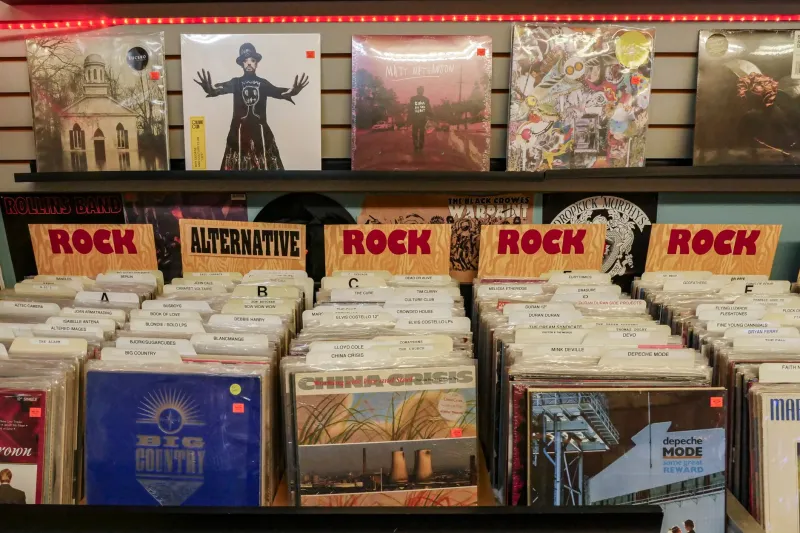
Walk into Golden Phoenix Records on the edge of Los Angeles' San Gabriel Valley and you'll immediately notice a few things. The smell of aging cardboard sleeves. A hand-painted sign advertising "Japanese pressings — ask at counter." And, almost certainly, the faint pulse of a familiar melody drifting from somewhere in the back.
Chances are good it's ABBA.
This isn't an accident. Across America's major cities — from the Koreatown corridors of L.A. to the Flushing neighborhoods of Queens to the Bellaire district of Houston — independent record shops rooted in Asian immigrant communities have become something nobody planned for: living, breathing archives of ABBA's cultural significance. Not just the music itself, but the stories wrapped around it. The why and how of an entire generation of Asian immigrants who latched onto four Swedes from Stockholm and never let go.
More Than a Record Store
Ming-Wei Chen has run his shop, Jade Needle Records, in Chicago's Chinatown for going on 22 years. He'll tell you straight up that he didn't set out to become an ABBA specialist. "I started with Cantopop, Taiwanese folk, a little Japanese city pop," he says, leaning against a wall of neatly filed LPs. "But customers kept bringing in their own records to sell — things they brought from Hong Kong, from Taiwan, from the Philippines — and ABBA just kept showing up."
Over time, he started paying attention. The copies people brought in weren't American pressings. They were imports — Thai pressings with different cover art, Indonesian releases with liner notes translated into Bahasa, Hong Kong editions with catalog numbers you'd never find on any mainstream collector's database. Each one was a small artifact of the band's extraordinary reach across Asia during the 1970s and '80s.
Ming-Wei now keeps a dedicated section. He calls it, with a slight grin, "The Swedish Corner."
The Import Rabbit Hole
For serious ABBA collectors, Asian pressings occupy a fascinating and often undervalued corner of the hobby. Japan, in particular, produced some of the most sought-after editions — renowned for their audio quality, elaborate obi strips, and occasional bonus tracks that never appeared on Western releases. But beyond Japan, the trail gets even more interesting.
Susan Park, who owns Starlight Groove in Flushing, Queens, has spent years sourcing records through networks that stretch back to Seoul, Manila, and Taipei. "People don't realize how big ABBA was in Southeast Asia specifically," she explains. "In the Philippines, in Thailand, in Indonesia — these records were everywhere. And when families immigrated, a lot of them came with their records. Those collections eventually find their way to me."
She recently acquired a batch of Philippine pressings from the mid-1970s that she describes as "genuinely rare." The covers feature slightly different color palettes than their European counterparts, and one includes a promotional insert in Filipino that she's had partially translated. It now sits in a protective sleeve behind her counter, less for sale than for display.
"It's history," she says simply. "I'm not putting that in a random bin."
The Collectors Who Keep the Flame
Every shop owner interviewed for this piece had a version of the same story: a customer who comes in regularly, knows more about ABBA pressings than anyone they've ever met, and whose devotion to the music is inseparable from their family history.
At Golden Phoenix in the San Gabriel Valley, that person is a retired engineer in his late 60s named David Lim, who emigrated from Malaysia in the early 1980s. He started collecting ABBA records as a teenager in Kuala Lumpur and never stopped. His collection now runs to several hundred pressings from across Asia, Europe, and Australia. He visits the shop most Saturdays.
"When I first came to America, ABBA was already on the radio here," he recalls. "But it felt different hearing it here than it did back home. Back home, it was — I don't know how to explain it — it was ours. We had claimed it somehow."
That sense of cultural ownership is something shop owners across the country describe hearing again and again. For many Asian immigrants, ABBA wasn't just Western pop music that happened to cross an ocean. It was music that arrived in their countries, got absorbed into their lives, and became part of the texture of their own cultures. The records they carried with them when they immigrated weren't nostalgia objects — they were proof.
Counterculture in the Streaming Age
It would be easy to frame these shops as relics — charming anachronisms holding out against the inevitable tide of Spotify and Apple Music. But that framing misses what's actually happening inside them.
Younger Asian-American customers are showing up. Not in overwhelming numbers, but consistently enough that shop owners have noticed a shift over the past three or four years. Some come in specifically hunting for ABBA vinyl, often prompted by a parent or grandparent's collection. Others stumble onto it.
"A kid came in last month — maybe 22, 23 — and asked me if I had any ABBA in Japanese pressing," says Susan Park. "I asked him how he knew to look for that specifically. He said his grandmother had one and he wanted to find another copy so he could keep hers in better condition."
That's not nostalgia. That's transmission.
Ming-Wei Chen sees his shop as something more than a retail space for exactly this reason. "We're informal museums," he says, without any irony. "Nobody is funding us to do this. Nobody designated us cultural institutions. But this is what we are."
The economics are genuinely difficult — rent in urban Asian neighborhoods has climbed sharply, foot traffic is unpredictable, and the collector market for vinyl, while healthy, is not a guaranteed income stream. Several shops that served similar functions have closed in recent years, their inventories scattered to eBay or estate sales, their institutional knowledge simply gone.
The ones that survive do so through a combination of community loyalty, careful curation, and the kind of word-of-mouth reputation that no algorithm can replicate. They also, increasingly, function as gathering spaces — hosting listening sessions, informal meetups, and the occasional impromptu conversation about the particular magic of a well-pressed copy of "The Album" from 1977.
Why This Matters
There's a version of ABBA's history that gets told in coffee table books and museum exhibits — the one about four talented Swedes who conquered the world with irresistible pop songwriting and then broke up, leaving behind a catalog that somehow only got more beloved with time.
That story is true. But it's incomplete.
The fuller version includes the record shops in Kuala Lumpur and Manila and Bangkok that stocked their albums. The immigrant families who packed those records into suitcases. The stores in San Gabriel and Flushing and Chinatown that inherited those collections and understood what they represented.
If you want to understand why ABBA's music has the particular emotional weight it carries for so many Asian and Asian-American fans, you don't need to go to Stockholm. You can start right here — in a slightly cramped shop that smells like old cardboard, where the owner knows every pressing by sight and can tell you exactly which copy came from which family.
That's not a conspiracy. That's just history, doing what history does — surviving in the places nobody thinks to look.