Mom's Vinyl, My Playlist: How Asian-American Gen X Parents Are Raising Kids Who Actually Want to Hear ABBA
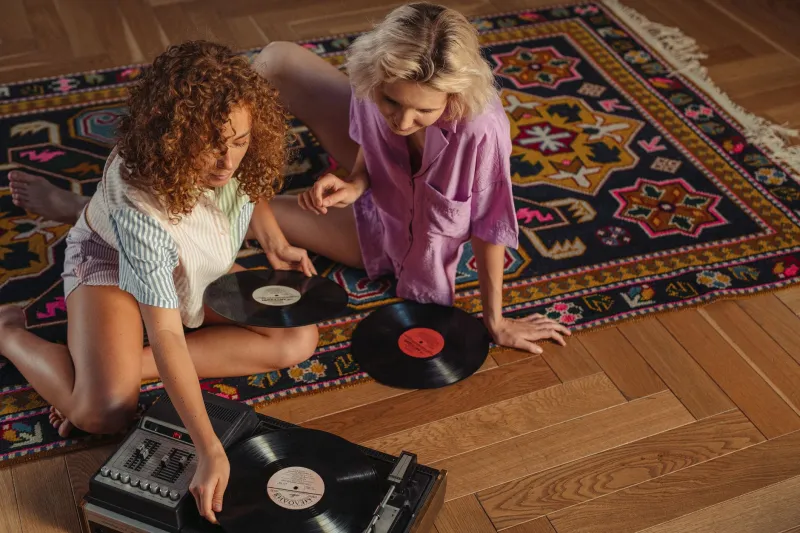
There's a moment that Priya Subramaniam, a 47-year-old software engineer in Fremont, California, says she'll never forget. Her twelve-year-old daughter walked into the living room one Sunday morning, picked up a battered copy of Arrival from the record crate, and asked — completely without irony — if they could listen to it together.
"I'd been playing ABBA since she was a baby," Priya says. "But this was different. She chose it. She wanted to know the story behind it."
That story, for Priya, started in Chennai. Her parents had discovered ABBA through shortwave radio broadcasts in the late 1970s, and when they immigrated to the U.S. in 1983, a small stack of cassette tapes made the journey with them. Those tapes became Priya's first real pop education. Now, decades later, the music has looped back around — this time landing with a generation of kids who technically have access to every song ever recorded and are still choosing to sit on the floor with a record player.
This isn't a one-family quirk. Across the country, in households that stretch from Vietnamese-American communities in San Jose to Korean-American families in Flushing, Queens, something quietly remarkable is happening. Gen Alpha kids — those born roughly from 2010 onward — are not just tolerating their Gen X parents' ABBA collections. They're actively curious about them.
Why ABBA, of All Things?
It's worth asking why this particular band keeps clearing the generational hurdle when so much other parent-culture gets met with a polite but firm "that's so old." ABBA tribute nights at local venues fill up fast. The Stockholm museum draws visitors from across Asia every year. And somehow, Fernando still makes people cry in car rides.
Part of the answer might be structural. ABBA's songs are genuinely, almost stubbornly, well-built. The melodies are sticky without being manipulative, the harmonies are complex enough to reward repeated listening, and the production — even on those early 70s recordings — holds up in a way that a lot of era-specific pop simply doesn't. When a Gen Alpha kid hears "Dancing Queen" for the first time without any context, it doesn't feel dated. It just feels good.
But for Asian-American families specifically, there's an emotional layer that goes beyond pure musicality.
"My parents came from South Korea in 1979," says James Yoon, a 44-year-old high school teacher in suburban Atlanta. "ABBA was one of the first things that made them feel like they understood American pop culture — even though ABBA isn't even American. There was something about it being universal, not belonging to any one place, that made it feel accessible."
James has been playing ABBA for his two kids, ages nine and thirteen, since they were toddlers. His oldest recently started asking him to explain what life was like for her grandparents when they first arrived in the States. ABBA, weirdly, became the entry point for that conversation.
"She heard 'The Winner Takes It All' and asked me what it was about," he says. "That opened up this whole talk about loss and starting over. I ended up telling her about my mom's first year here, how lonely it was. I don't think we would've gotten there without the song."
Disco Literacy as a Form of Cultural Inheritance
The phrase "disco literacy" might sound a little academic for a Sunday afternoon in the living room, but it captures something real. These Gen X parents aren't just sharing a playlist — they're passing down a whole framework for understanding a particular moment in history, a specific emotional vocabulary, and a set of cultural references that connect them to their own parents' immigrant experience.
For many Asian-American families, ABBA arrived at a pivotal moment. The 1970s and early 80s were a complicated time to be an immigrant in the United States. The music playing on mainstream radio wasn't always welcoming, and the cultural landscape could feel alienating. ABBA, with its clean production, universally legible emotional themes, and complete lack of American cultural gatekeeping, slipped through. It didn't require insider knowledge to enjoy. It just asked you to feel something.
That openness is part of what makes it so transferable now.
Linda Chen, a 49-year-old graphic designer in Chicago whose parents immigrated from Guangzhou, describes putting on Super Trouper for her ten-year-old son during a long road trip last summer. "He started asking questions immediately. 'Who are these people? Why do they sound so happy? Why does this song make you sad?' And I realized — that's the whole thing right there. That tension is the whole immigrant experience in four minutes."
Her son has since started watching YouTube videos about ABBA's history and asked for a record player for his birthday. Linda is still a little stunned by it.
The Algorithm Doesn't Know Your Grandmother
One thing several parents brought up independently: streaming platforms, for all their remarkable convenience, are genuinely terrible at transmitting emotional context. An algorithm can surface a song based on listening patterns, but it can't tell a kid why a particular record matters, who bought it and when, what it felt like to hear it for the first time in a country where you didn't quite belong yet.
Vinyl, as a physical object, carries that weight in a way a Spotify queue simply can't.
"There's something about handing her the record, showing her how to put the needle down," says Priya. "She's learning that music has a physical history. It existed somewhere before it existed in her ears."
This tactile dimension seems to be part of what's catching Gen Alpha's attention. These are kids who have grown up with frictionless access to virtually everything, and that frictionlessness, it turns out, can feel a little hollow. A scratchy vinyl pressing of Voulez-Vous with a coffee ring on the sleeve has a story. The algorithm-generated playlist does not.
What Gets Passed Down
Not every family frames it in grand cultural terms. Sometimes it's simpler than that — a Saturday cleaning ritual soundtracked by Waterloo, or a car karaoke tradition that's been running since the older kid was in a car seat. But even in those lighter versions, something is moving between generations.
James Yoon puts it plainly: "I'm not trying to make my kids into ABBA scholars. I just want them to know where some of their joy comes from. And some of my joy comes from watching my parents feel at home in this country for the first time, singing along to a Swedish pop group in our tiny apartment in Atlanta."
That's the ABBA effect, maybe. Not nostalgia exactly — more like a living thread. A sound that helped one generation land softly in a new world, and that keeps finding new reasons to matter to the people those immigrants raised, and the people those people are raising now.
The record keeps spinning. Somebody new always wants to hear what the fuss is about.