When Dancing Queen Becomes a Family Heirloom: ABBA as the Secret Language Between Asian Immigrant Parents and Their American Kids
Mei-Ling Huang still remembers the exact moment she realized something had shifted. She was sixteen, sulking in the backseat of her parents' Honda Odyssey somewhere on the I-95, earbuds firmly in, when her mother turned up the car stereo loud enough to break through. The song was Dancing Queen. Her mom — a Taiwanese immigrant who had worked double shifts at a restaurant for most of Mei-Ling's childhood — was singing along. Word for word. Completely unselfconscious.
"I pulled out one earbud," Mei-Ling, now 24 and living in Philadelphia, told us with a laugh. "And then I pulled out the other one. I didn't know she even knew ABBA."
She did. Turns out, a lot of Asian immigrant parents do.
A Soundtrack That Crossed More Than One Ocean
ABBA's reach into Asian markets is well-documented — the group's music saturated radio stations and department store speakers from Tokyo to Manila throughout the late '70s and '80s. For many first-generation immigrants who came to the United States during that era or shortly after, ABBA wasn't foreign music. It was the soundtrack of their young adulthood, a memory tied to first jobs, first loves, and the particular kind of optimism that comes before life gets complicated.
What nobody anticipated was that this music would resurface decades later — not just on streaming platforms and in Broadway theaters, but inside American living rooms, functioning as a kind of emotional bridge between parents and the children they were sometimes struggling to reach.
Dr. Sunita Patel, a family therapist based in the San Francisco Bay Area who works extensively with South Asian immigrant families, has started noticing the pattern in her practice. "Music is one of the fastest routes to emotional memory," she explained. "When a parent hears a song from their formative years, they don't just remember it — they feel it again. And kids are perceptive. They pick up on that openness, that vulnerability. It creates an opening."
More Than Nostalgia — It's Permission
For many Asian immigrant parents, the cultural script around emotional expression can be tight. Duty, sacrifice, and practical love often take precedence over the kind of open, verbal affection that American parenting culture tends to celebrate. That gap — real or perceived — is something a lot of second-generation kids grow up navigating.
But ABBA, it turns out, gives people permission.
Jason Park, 28, grew up in suburban New Jersey in a Korean-American household where his parents rarely talked about feelings directly. "There was love, obviously, but it was shown through actions — food on the table, tuition paid, that kind of thing," he said. "Conversations about emotions just weren't really a thing."
That started to change, unexpectedly, around the time his mother discovered Mamma Mia! on Netflix. She watched it twice in one weekend. Then she started playing ABBA around the house. Then she started asking Jason if he remembered this song or that one from when he was little.
"She'd never really talked about her life before she came to the US," Jason said. "But ABBA opened that up somehow. She told me she used to listen to The Winner Takes It All on repeat after a breakup she'd never mentioned before. I was like — wait, you had a whole life I don't know about."
That realization — that a parent is also a full human being with a past — is something therapists often describe as a breakthrough moment in intergenerational relationships. And ABBA, of all things, keeps delivering it.
The Karaoke Connection
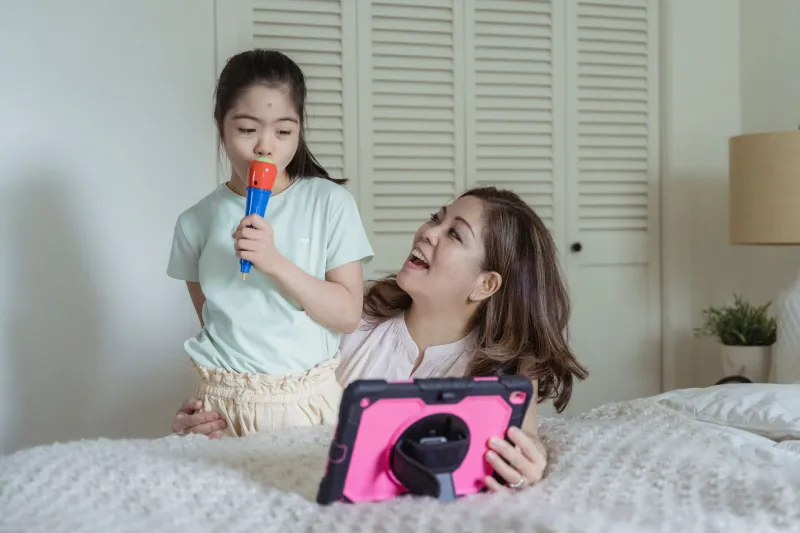
It would be impossible to talk about ABBA in Asian-American households without talking about karaoke. The overlap between ABBA's catalog and the standard karaoke songbook is massive, and for families that might not otherwise find an easy social activity, karaoke nights have become genuinely meaningful rituals.
Amanda Santos, a Filipino-American college student in Los Angeles, described her family's annual New Year's Eve karaoke tradition as the one event where generational tension fully dissolves. "My lola, my parents, my cousins — we're all fighting over the mic for Voulez-Vous and Gimme! Gimme! Gimme!," she said. "There's no language barrier in that moment. There's no gap between what they grew up with and what I grew up with. We're just all screaming ABBA together."
She paused, then added: "Honestly, I think karaoke is doing more for our family communication than any conversation we've ever had."
Why ABBA Specifically?
It's worth asking why ABBA keeps coming up in these stories rather than, say, the Bee Gees or Elton John — other artists with significant global footprints from the same era. Part of it is probably the Mamma Mia! franchise, which reintroduced the catalog to a new generation with enough emotional weight to make it feel meaningful rather than campy. Part of it is streaming, which has made the music frictionlessly accessible.
But there's also something in the songs themselves. ABBA wrote about longing, about love that doesn't quite work out, about finding joy despite uncertainty — themes that land differently when you're someone who left everything familiar behind to build a new life in a country that didn't always make it easy. Fernando hits differently when you've actually crossed something. The Winner Takes It All hits differently when you've had to sacrifice things quietly, without applause.
"The emotional directness of ABBA's lyrics is deceptively powerful," said Marcus Lee, a music writer and second-generation Chinese-American based in New York. "They're simple on the surface but they carry a lot of weight. That's actually a pretty rare quality in pop music. And I think people who've had to be emotionally restrained in other parts of their lives respond to that directness in a big way."
Building the Bridge, One Song at a Time
None of this is to suggest that a few ABBA albums solve the very real and complex challenges of intergenerational immigrant family dynamics. The pressures of assimilation, the weight of expectation, the grief of cultural dislocation — these are serious things that don't dissolve with a chorus of Waterloo.
But what ABBA seems to do, in household after household, is create a moment of mutual recognition. A moment where a parent gets to be seen as someone who once danced and dreamed and felt things intensely. And where a kid gets to see that, and feel a little less alone in their own emotional life.
Mei-Ling, the young woman from the backseat of that Honda Odyssey, said she and her mother now have a playlist they built together. It started with ABBA and has grown to include other things — songs her mom loved in Taiwan, songs Mei-Ling has introduced her to. "It's become this ongoing thing between us," she said. "Like a conversation we're always adding to."
She smiled. "It started with Dancing Queen. I guess that's kind of perfect, actually."